What Is a TFT Screen in Motorcycles? How It Works

Motorcycle instrument clusters have evolved beyond traditional speedometers and warning lights. Many modern motorcycles now feature colour digital displays that show riding information, navigation and smartphone notifications. These displays are known as TFT screens.
But what does TFT mean? How does it work, and how is it different from a regular LCD display? Let’s find out.
What Is a TFT Screen in a Motorcycle?
TFT stands for Thin-Film Transistor. It is a display technology that uses tiny transistors to control individual pixels, producing sharp text, detailed graphics and vibrant colours.
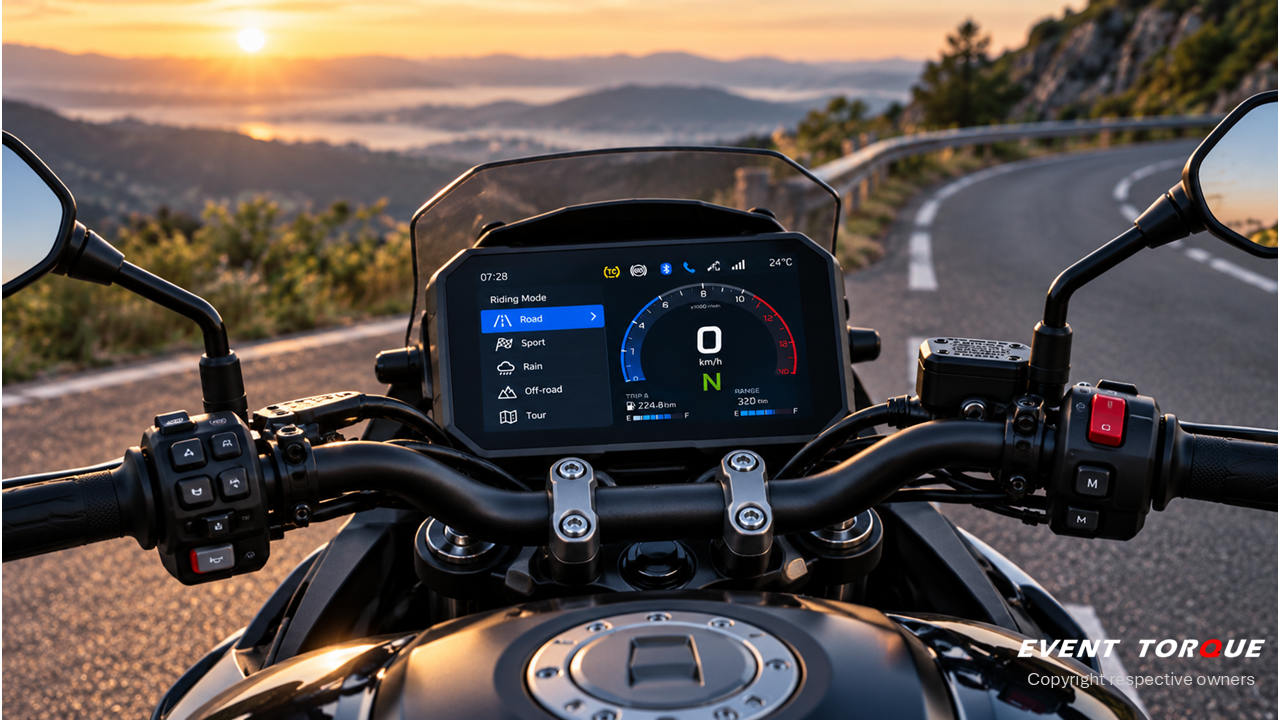
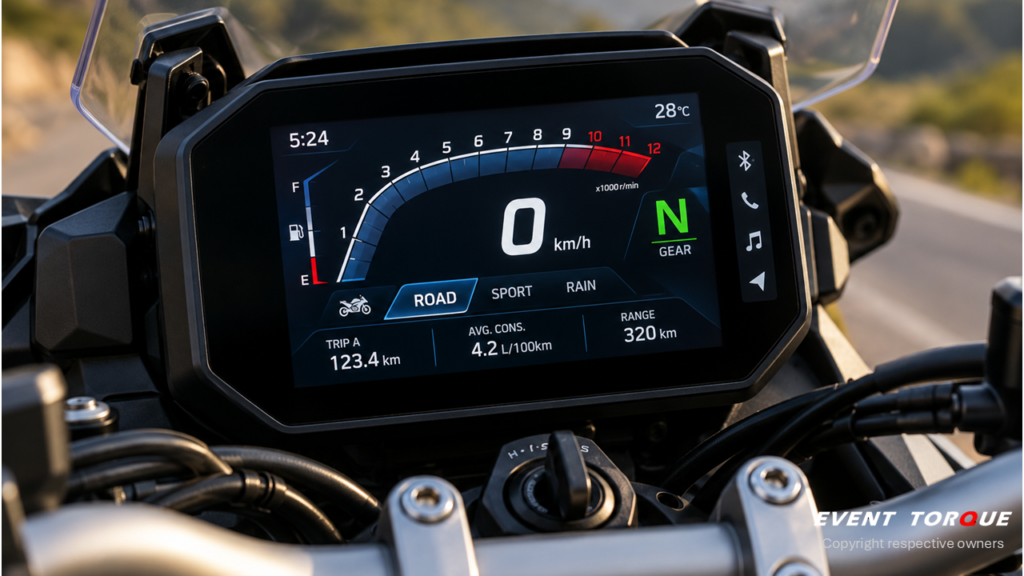
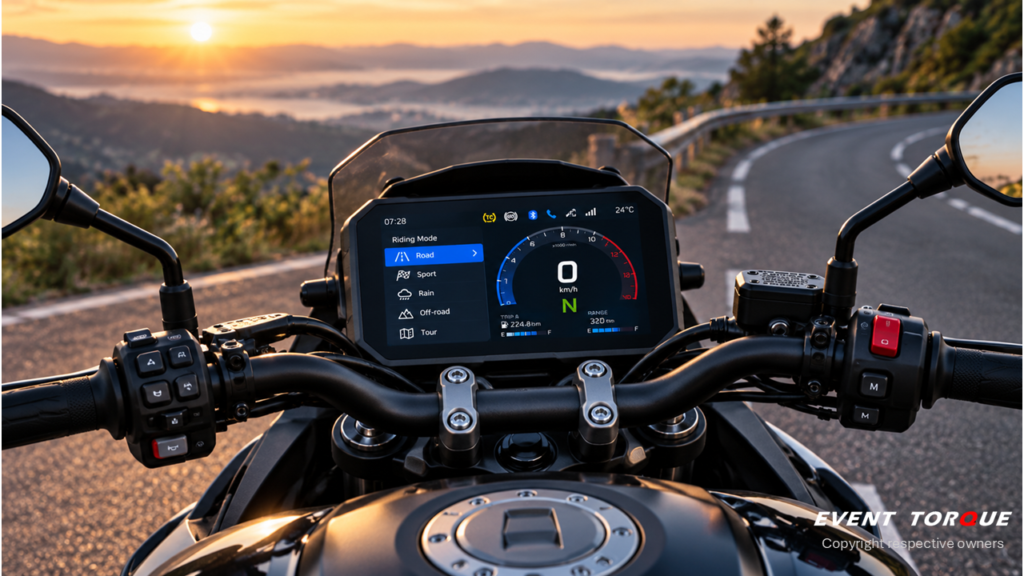
On a motorcycle, a TFT screen typically serves as the digital instrument cluster, displaying essential riding information such as speed, engine RPM, gear position, fuel level and trip data.
Depending on the model, it may also support turn-by-turn navigation, Bluetooth connectivity, music information, incoming call alerts and riding mode selection.
Unlike traditional analogue gauges or basic LCD (Liquid Crystal Display) displays, a colour TFT screen can present information through different layouts, graphics and colours, giving the rider a modern and interactive interface.
How Does a TFT Screen Work?
A motorcycle’s TFT instrument cluster receives information from various sensors and electronic control units. It processes this information and displays it in a readable format.
Here is how the system works:
- Sensors collect information: Sensors monitor parameters such as vehicle speed, engine RPM, fuel level and engine temperature.
- Electronic systems process the data: The ECU and other control modules process the relevant information and transmit it to the instrument cluster.
- The display processes the signals: The cluster’s electronics convert the information into numbers, symbols and graphics.
- The screen displays the information: The TFT panel presents the readings in a format the rider can understand.
For example, when the motorcycle accelerates, the speed sensor detects the change in speed. The electronic system processes this information, and the instrument cluster updates the speed reading on the screen.
In simple terms, the motorcycle’s electronics collect and process the information, while the TFT screen makes it visible to the rider.
What Can You See on a Motorcycle TFT Screen?
The information available depends on the motorcycle and the features offered by its manufacturer. Common functions include:
- Speed and engine RPM: Shows how fast the motorcycle is travelling and how quickly the engine is rotating.
- Gear position: Indicates the currently selected gear.
- Fuel level and riding range: Displays the remaining fuel and, on supported models, the estimated distance before refuelling.
- Riding modes: Shows the selected mode, such as Road, Rain or Sport, where available.
- Navigation: Provides turn-by-turn directions or maps on compatible systems.
- Smartphone connectivity: May display incoming calls, selected notifications and music information.
- Trip and vehicle data: Can show distance travelled, fuel consumption, temperature readings and service reminders.
Not every TFT screen includes all these functions. Some focus on basic riding information, while more advanced systems offer navigation, connectivity and additional customisation.
TFT vs LCD vs Analogue: What’s the Difference?
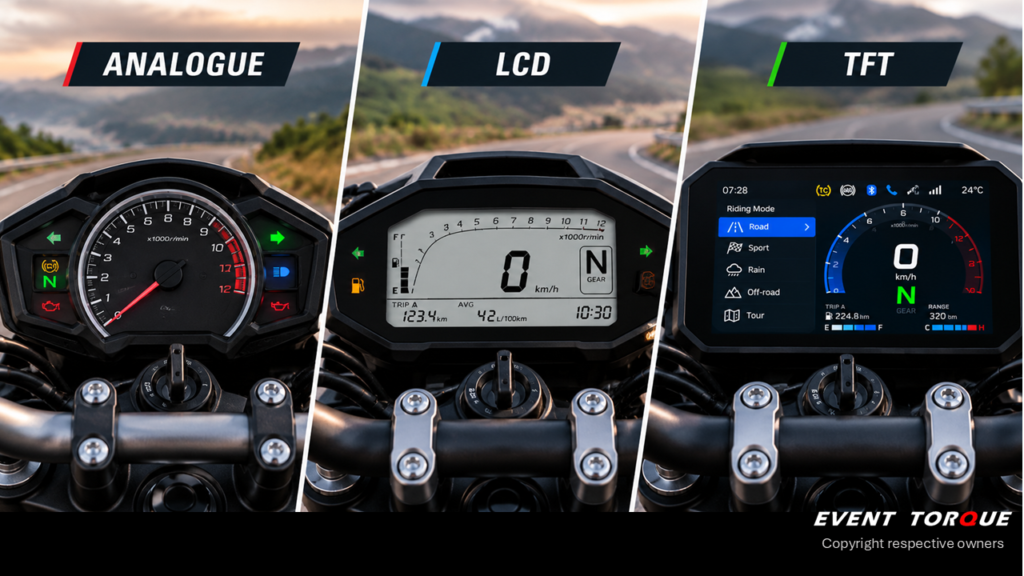
Motorcycles use different types of instrument clusters, and understanding the differences helps explain why TFT screens are becoming popular.
| Feature | Analogue | Basic LCD | Colour TFT |
|---|---|---|---|
| How information appears | Physical needle and dial | Digital numbers and symbols | Colour graphics and text |
| Display layout | Mostly fixed | Generally simple | More flexible |
| Navigation | Usually unavailable | Limited on some models | Available on supported models |
| Smartphone connectivity | Generally limited | Available on some models | Available on supported models |
| Appearance | Traditional | Functional | Modern and customisable |
An LCD display can be perfectly adequate for everyday riding, while an analogue cluster offers a familiar, straightforward layout. A TFT screen stands out because it can display richer graphics, change layouts and support more advanced features.
However, a TFT screen is not automatically easier to read or more useful. Its practicality depends on the quality of the display and how well the information is organised.
What Are the Benefits of a TFT Screen?
More information at a glance: Riders can view multiple readings and functions on one display instead of relying on separate indicators or accessories.
A modern interface: Colour graphics and flexible layouts allow manufacturers to present information in a visually organised manner.
Navigation support: Compatible systems can display directions, making unfamiliar routes and long-distance rides easier to manage.
Smartphone integration: Depending on the model, riders can access selected call, notification and music information through the instrument cluster.
Customisable displays: Some motorcycles allow riders to change the layout or prioritise different information according to their preferences or selected riding mode.
Why Are Motorcycle Manufacturers Switching to TFT Screens?
Motorcycle manufacturers are increasingly adopting TFT displays because they offer greater flexibility in presenting information. Unlike traditional instrument clusters, TFT screens can accommodate colour graphics, different display layouts and connected features within a single unit.
They also allow manufacturers to create a modern interface that complements the motorcycle’s design. Depending on the model, the same screen can display riding information, navigation and smartphone connectivity.
As motorcycle technology evolves, TFT displays provide a convenient way to bring multiple functions together in one place, giving riders access to more information through a single instrument cluster.
Conclusion
A TFT screen is a colour digital display that makes motorcycle information more accessible through graphics, flexible layouts and, on supported models, connected features such as navigation and smartphone integration.
Its biggest advantage is versatility. By combining multiple functions in one display, TFT technology allows manufacturers to create more informative and customisable instrument clusters. Ultimately, the value of a TFT screen lies in how effectively it presents important information while keeping the rider focused on the road.